Exterior Shutter Hinges
Written by ShutterLand, a U.S. exterior shutter specialist with over two decades of hands-on experience in shutter measurement, material selection, finish options, and installation for residential homes and commercial properties.
Exterior shutter hinges allow functional shutters to swing between an open position beside the window and a closed position over the opening. The correct hinge depends on the shutter material, shutter size, window depth, mounting surface, and where the shutter needs to sit when closed.
This guide focuses primarily on hinges for side-mounted Colonial-style wood and PVC shutters. Premium wood exterior shutters and PVC exterior shutters can be installed with functional hinges. Vinyl and composite shutters are designed for fixed installation and do not use functional shutter hinges.
The hinge style and required offset should be considered while measuring for exterior shutters, before the shutters are ordered.
How Do Exterior Shutter Hinges Work?
Most traditional exterior shutter hinges have two primary components: a hinge attached to the shutter and a pintle attached to the house.
The pintle creates the stationary pivot point. The shutter-side hinge fits over or connects to the pintle, allowing the shutter to rotate between the open and closed positions.
Some hinge styles are surface-mounted to the face of the shutter. Others are mortised into the edge of the shutter and window casing.
Surface-Mount vs. Mortise Shutter Hinges
Most exterior shutter hinges fall into one of two installation categories.
| Hinge Type | How It Mounts | Common Use |
|---|---|---|
| Surface-mount hinge | Attaches to the face or back of the shutter | Wood and PVC shutters installed inside or in front of the window opening |
| Mortise hinge | Recessed into the shutter edge and window casing | Wood or PVC shutters that fit within the window opening |
Surface-Mount Shutter Hinges
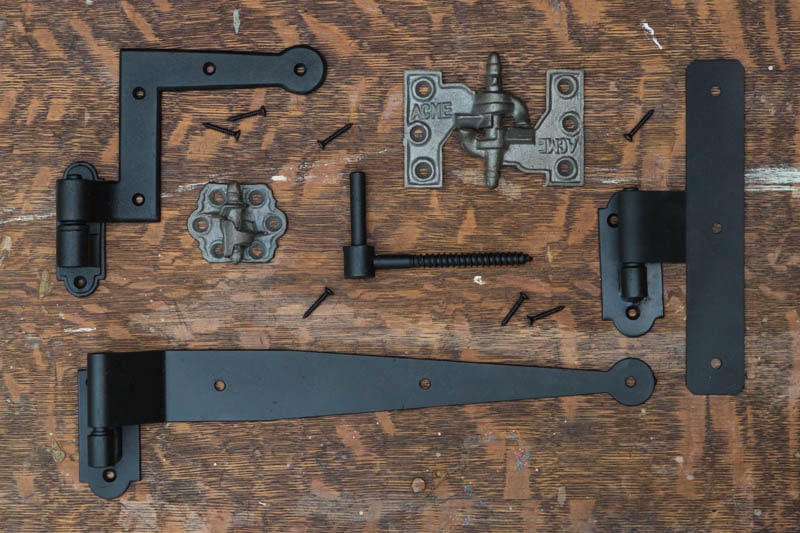
Surface-mount hinges attach directly to the shutter without cutting a recess into the shutter edge. Strap hinges and New York-style L-hinges are common examples.
These hinges are versatile because they can be used when the shutters close inside a sufficiently deep window opening or when the shutters need to close in front of a shallow opening.
Mortise Shutter Hinges
Mortise hinges fit between the outside edge of the shutter and the window casing. A shallow recess, or mortise, is cut into both surfaces so the hinge leaves can sit properly.
This arrangement is generally used when the shutter fits within the window opening.
Common Types of Exterior Shutter Hinges
Horizontal Strap Hinges
Horizontal strap hinges are one of the most common choices for traditional exterior shutters.
The long strap attaches to the face of the shutter, usually centered on the top and bottom rails. The opposite end fits over a pintle mounted to the window casing or surrounding structure.
Strap hinges are available in multiple lengths, offsets, and decorative profiles. They work well with both functional wood shutters and properly supported functional PVC shutters.
A standard strap hinge is generally concealed behind the shutter when the shutter is open.
Reverse-mount strap hinges attach to the back of the shutter instead. This configuration can make more of the hardware visible when the shutter is open.
New York-Style L-Hinges
New York-style hinges, commonly called L-hinges, operate much like traditional strap hinges but use an L-shaped shutter leaf.
The configuration can be useful for narrower shutters, situations where the pintle needs to be positioned differently, or when the L-shaped appearance is preferred.
Both traditional strap hinges and New York-style hinges are commonly used in ShutterLand’s wood shutter installation instructions and PVC shutter installation instructions.
Vertical Strap Hinges
Vertical strap hinges run along the stile rather than across a horizontal rail.
They are often useful when an additional center hinge is needed but there is no divider rail available for a conventional horizontal strap hinge.
Clarks Tip Hinges
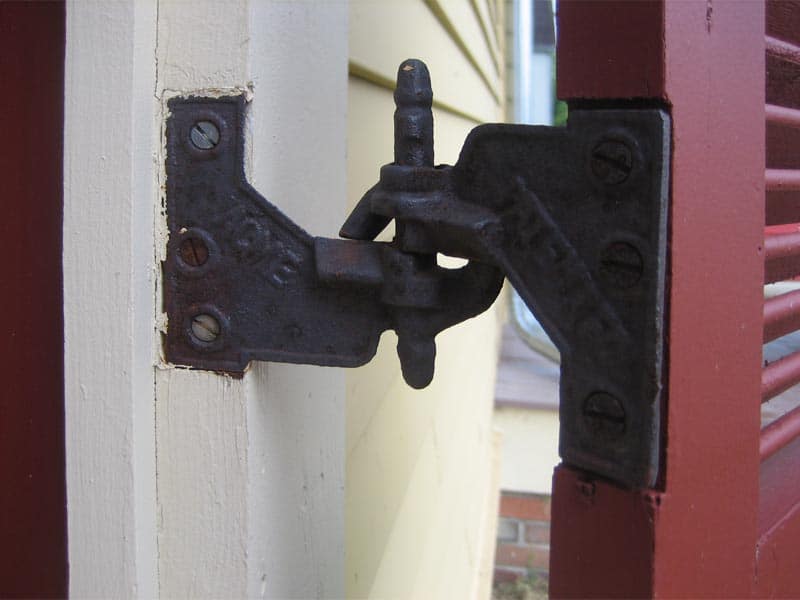
Clarks Tip hinges are surface-mounted hinges designed so one leaf attaches to the shutter and the other to the window casing.
The two mounting surfaces generally need to be on the same plane. When the shutter is open, much of the hinge is concealed.
The hinge is also designed to help hold the shutter in the open position. Raising the shutter slightly releases it so the panel can swing closed.
Acme Lull & Porter Hinges
Lull & Porter hinges operate in a similar manner to Clarks Tip hinges but are mortised between the shutter stile and the side of the window casing.
They are a traditional hinge choice frequently associated with historic and period shutter installations.
Butt and Edge-Mortise Hinges
A conventional butt hinge can also be used in some inset wood and PVC shutter applications.
The hinge leaves are mortised into the edge of the shutter and the adjacent window casing. Butt hinges have a simpler appearance than Lull & Porter hinges and generally do not include a built-in mechanism for holding the shutter open.
When using butt hinges on PVC shutters, the hinge arrangement still needs to provide the required number of support points for the shutter.
What Is Shutter Hinge Offset?
Hinge offset determines where the shutter pivot point sits in relation to both the shutter and the building.
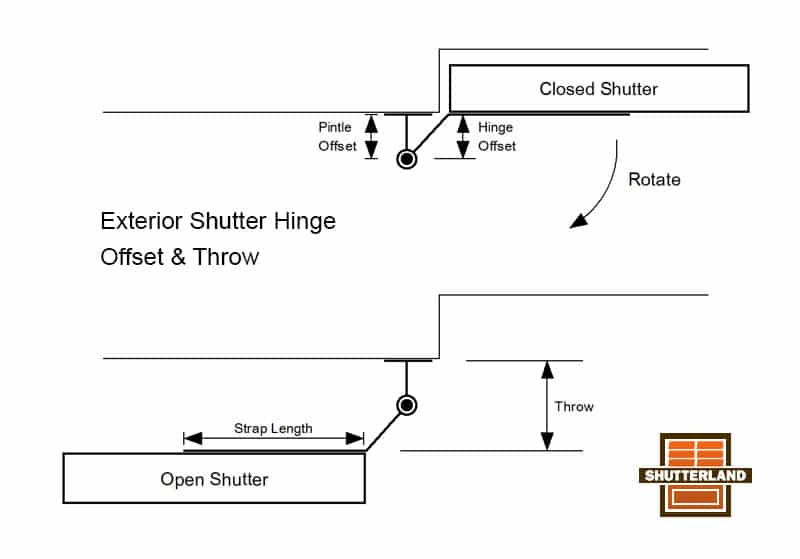
The pintle offset is the distance from the pintle mounting surface to the center of the pivot.
The hinge offset is the distance from the shutter mounting surface to that same pivot point.
When a shutter closes within a recessed window opening, the hinge and pintle often have matching offsets.
When the shutter must close in front of the window or casing, a pintle with a greater offset may be needed to properly position the shutter.
What Is Shutter Hinge Throw?
Throw describes how far the shutter sits away from the pintle mounting surface when the shutter is open.
The throw is determined by the combined hinge and pintle offsets.
A greater throw may be necessary when the open shutter needs to clear siding, trim, masonry, or another feature projecting from the wall.
This is why hinge selection should be completed during the measuring process rather than after the shutters arrive.
See the complete wood shutter measuring guide or PVC shutter measuring guide before ordering functional shutters.
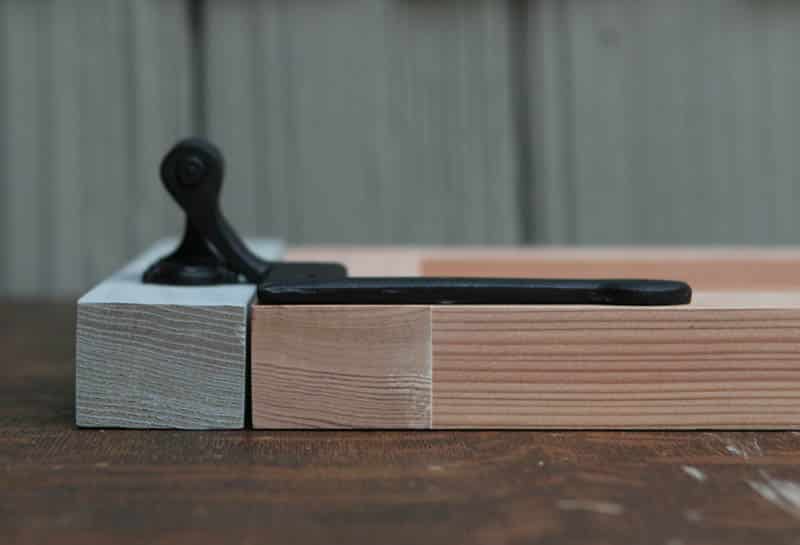
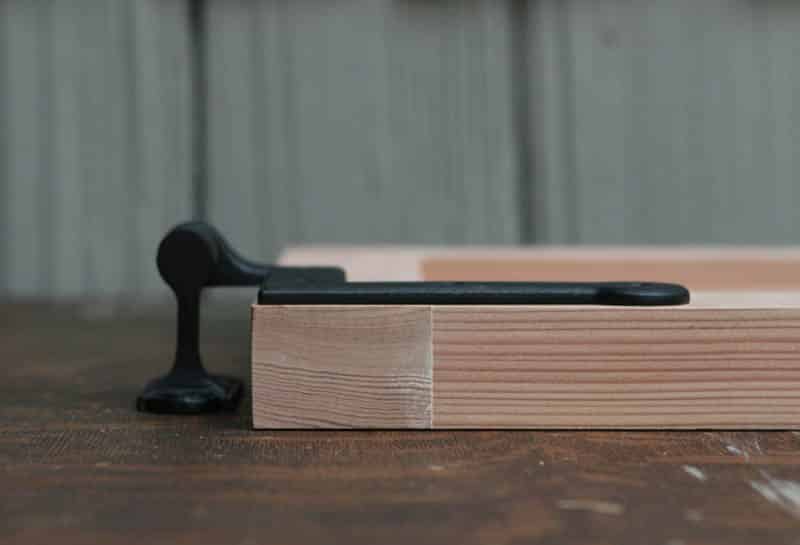
Plate-Mount vs. Lag-Mount Pintles
The type of surface surrounding the window can also influence pintle selection.
Plate-Mount Pintles
A plate-mount pintle has a flat base secured with multiple screws. It works particularly well on flat wood trim and other surfaces capable of accepting the mounting screws.
Lag-Mount Pintles
Lag-mount pintles use a long threaded shaft instead of a mounting plate.
They can be useful where a conventional plate cannot sit flat or where the pintle must anchor into a deeper structural surface. Masonry applications may require an appropriate predrilled hole and masonry anchor.
The correct fastener and anchor should always be selected for the building material.
Where Should Shutter Hinges Be Positioned?
Surface-mounted strap and L-hinges should normally align with the horizontal structural rails of the shutter.
The upper hinge is centered on the top rail and the lower hinge is centered on the bottom rail.
When an additional hinge is required, it can often align with a divider rail. If there is no divider rail, another compatible hinge style or support location may be necessary.
Mortise and narrow surface-mounted hinges are typically positioned along the shutter stile rather than extending across a rail.
How Many Hinges Do Exterior Shutters Need?
The correct number of hinges depends on the shutter material, height, weight, construction, and hinge style.
Wood Shutters
Many wood shutters can be supported with two appropriately sized hinges, one at the top and one at the bottom.
Larger or heavier shutters may require a third or fourth hinge. A divider rail can provide a convenient structural location for an additional strap hinge.
Review the wood shutter measuring instructions before ordering large functional shutters.
PVC Shutters
PVC shutters are solid and relatively heavy, so functional installations require additional points of support.
PVC shutters under 84 inches tall require a minimum of four points of contact with the building:
Top hinge — Bottom hinge — Mid hinge — Shutter support
PVC shutters 84 inches tall or greater require a minimum of five points of contact:
Top hinge — Bottom hinge — Two intermediate hinges — Shutter support
Larger shutters or unusual installations may require additional support.
The lower shutter support works with the shutter hardware to help carry the weight of the panel when it is resting in the open position. Review the complete PVC shutter installation instructions before installation.
Do Exterior Shutters Need Shutter Dogs?
Traditional strap and L-hinges allow the shutters to swing but generally do not hold them against the wall when open.
A shutter dog mounts below the open shutter and rotates into position to restrain the panel.
Some specialized hinges, including Clarks Tip and Lull & Porter hinges, incorporate a mechanism that hold the shutter open.
Shutter dogs may still be used for appearance, support, or to complement the architectural style of the house.
Can You Put Hinges on Vinyl Shutters?
No. ShutterLand vinyl shutters are hollow molded shells designed for stationary installation.
They do not have the solid structure necessary to support the shutter from functional hinge screws.
Vinyl shutters can instead be permanently installed with the appropriate fixed mounting fasteners. Decorative faux hinges can be added when the appearance of traditional shutter hardware is desired.
Can Composite Shutters Be Installed With Hinges?
ShutterLand composite shutters are also designed for stationary installation.
They use fixed mounting brackets rather than functional hinges and are not intended to swing open and closed.
Homeowners who want operable Colonial shutters should consider wood or PVC.
Do Bahama Shutters Use the Same Hinges?
No. Bahama shutters hinge horizontally across the top of the shutter rather than vertically along the sides.
Wood and PVC Bahama shutters use a continuous top hinge combined with support arms that hold the lower portion of the shutter away from the building.
See the separate Bahama shutter installation guide for hinge selection and installation.
Aluminum hurricane shutters also use product-specific hardware and should be installed according to the requirements of the individual shutter system.
Choosing the Right Exterior Shutter Hinge
Select exterior shutter hinges while measuring the window rather than after the shutters have been manufactured.
The right hinge needs to account for the shutter material, shutter size and weight, mounting surface, window depth, closed position, required throw, and available structural mounting points.
Start with the exterior shutter measuring guides to determine the shutter dimensions and installation position. Then review the available exterior shutter hardware and select the hinge configuration that fits the window and shutter.
Properly selected hardware allows functional exterior shutters to swing smoothly, rest correctly beside the window, and close in the position intended.